
Best Wordtune Alternatives for Non-Native English Speakers (2026)

Wordtune is a solid rephrase tool. But if you're a non-native English speaker, you may have noticed it polishes word choice without fixing the deeper problem: your text still reads non-native. Here are five alternatives — what each one does best, where it falls short, and which to pick.
Disclosure: Limato is our product. We've tried to keep this comparison honest — every tool below has real strengths, and the right pick depends on what you're actually trying to fix. Pricing reflects publicly listed monthly-billed plans as of May 2026; annual billing is typically cheaper across all tools.
Why people look for a Wordtune alternative
Wordtune does one thing well: take a sentence, give you 3–5 rephrased versions to pick from. Useful when you're stuck. Less useful when you have ten sentences in an email that all sound stiff and non-native.
The most common reasons we hear from users switching:
- Pricing. Wordtune Unlimited runs $19.99/mo; the Advanced tier at $13.99/mo caps you at 30 rewrites/day. Heavy writers hit the ceiling fast.
- Limited languages. Wordtune works in English, Spanish, and a handful of others. Translators and multilingual writers often want broader coverage.
- No native-tone mode. It rephrases — it doesn't aggressively cut ESL patterns like "I hope this email finds you well" or replace literal translations with idiomatic phrasing.
- Sentence-by-sentence flow. Rewriting one sentence at a time gets tedious for full emails.
What "non-native" actually looks like
Before comparing tools, look at the problem. Below is a real-world ESL email opener — the kind of paragraph a fluent-but-non-native writer produces every day. Then the same text after each tool's strongest rewrite mode.
I hope this email finds you well. I am writing to you in order to kindly ask about the possibility of scheduling a short call regarding the project we have discussed previously. As I have mentioned in our last conversation, I would really appreciate if we could find a time that works for both of us in order to align on the next steps.
Methodology: none of the other tools have a "Native" mode, so we tested each tool's closest equivalent — Wordtune Casual, QuillBot Fluency, Grammarly Clarity — the modes that target the same goal (cutting fluff, sounding fluent). Single run, default settings, no cherry-picking.
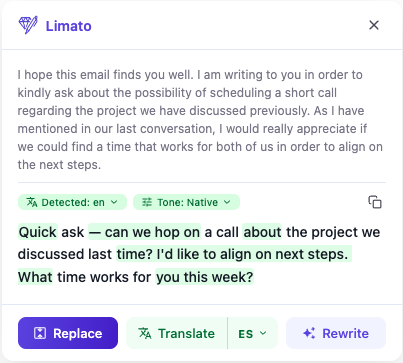
Quick ask — can we hop on a call about the project we discussed last time? I'd like to align on next steps. What time works for you this week?
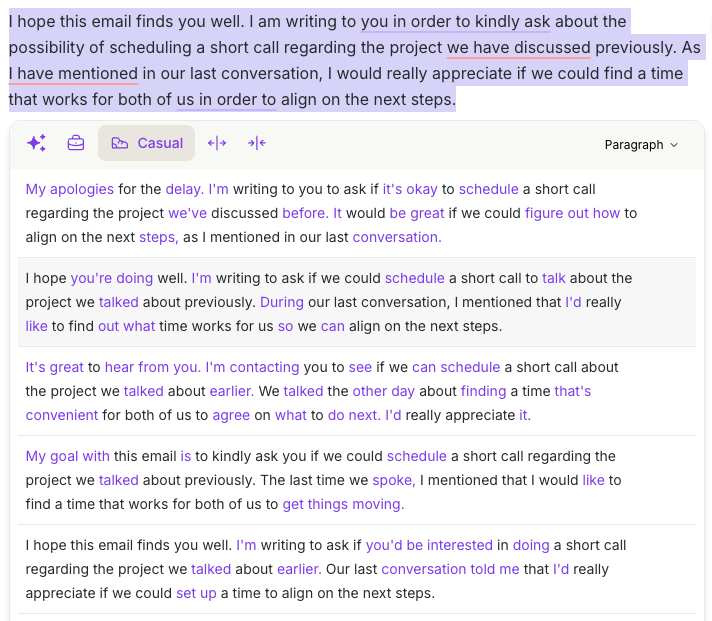
My apologies for the delay. I'm writing to you to ask if it's okay to schedule a short call regarding the project we've discussed before. It would be great if we could figure out how to align on the next steps, as I mentioned in our last conversation.
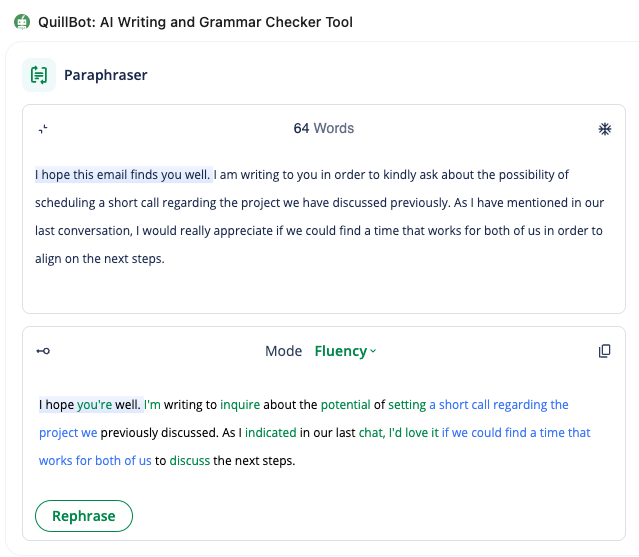
I hope you're well. I'm writing to inquire about the potential of setting a short call regarding the project we previously discussed. As I indicated in our last chat, I'd love it if we could find a time that works for both of us to discuss the next steps.
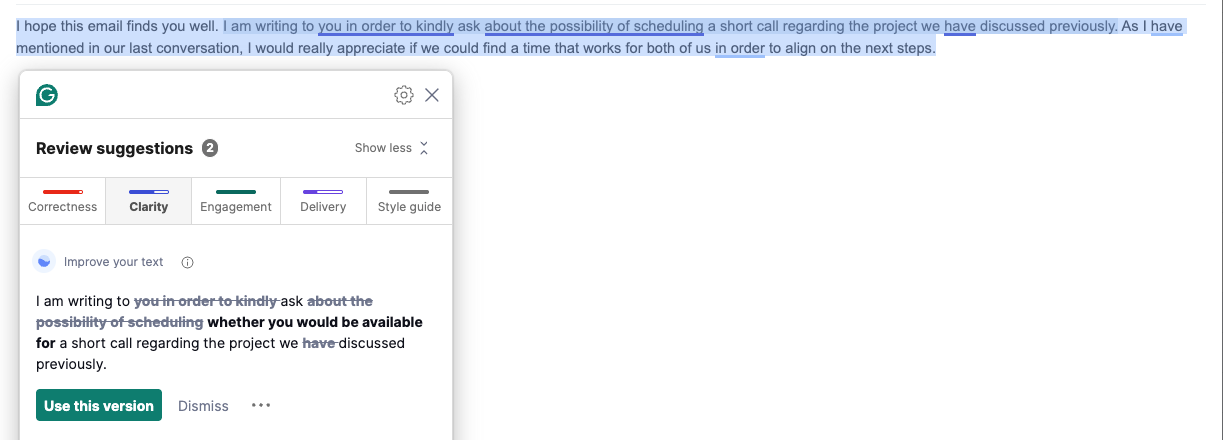
I hope this email finds you well. I am writing to ask whether you would be available for a short call regarding the project we discussed previously. As I have mentioned in our last conversation, I would really appreciate if we could find a time that works for both of us in order to align on the next steps.
Same input, four very different outputs. Pattern is clear: grammar tools (Grammarly Clarity) polish the surface but keep the ESL scaffold intact (−8%). Paraphrase tools (Wordtune, QuillBot) cut more wordiness (−23%) but preserve formal register, mix tones, and — in Wordtune's default suggestion in our test — added content not present in the source. A native-tone rewrite restructures: drops the stiff opener, cuts hedges, halves the length (−55%) without inventing anything. That's the gap Limato is built to close.
How they compare
| Tool | Output length | Real rewrite? | Best for | Pricing |
|---|---|---|---|---|
| Limato | −55% | Yes | Non-native → native rewrites, tone variation | Free + $5.99/mo |
| QuillBot (Fluency) | −23% | Partial | Paraphrasing, students | Free + $19.95/mo |
| Wordtune (Casual) | −23% | Partial | Tone variation, brainstorming | Free + $19.99/mo |
| Grammarly (Clarity) | −8% | No | Grammar + spelling | Free + $30/mo |
| DeepL Write | n/a | — | Clarity rewrites, EU languages | Free + $10.49/mo |
| ProWritingAid | n/a | — | Long-form (books, reports) | Free + $30/mo |
1. Limato — the native-tone rewriter for ESL writers
Best for: sounding like a native speaker
Limato is built around a single insight: non-native writing has recognizable patterns — formal openers, over-hedging, literal translations, missing articles, mechanical sentence rhythm — and a generic paraphrase tool doesn't fix any of them.
Highlight any text in Gmail, LinkedIn, Notion, Slack, or anywhere else you type, pick "Native" tone, and Limato rewrites it the way a fluent English speaker would — typically 40–55% shorter, with the ESL signals stripped out. There's also a translation mode across 34 major languages → idiomatic English. See the head-to-head in Limato vs Wordtune.
- Aggressive native rewrite, not just polish
- Inline on any webpage — no copy-paste
- Cheapest paid plan in this list
- Built for non-native speakers specifically
- Chrome only (Firefox/Safari coming)
- No long-form document editor
2. QuillBot — the paraphrase classic
Best for: students, paraphrasing, plagiarism rewrites
QuillBot is the original paraphrase tool. Multiple modes — Standard, Fluency, Formal, Creative, Shorten, Expand — and a generous free tier. Popular with students and academic writers who need to rewrite source material in their own words. See the same-email test in Limato vs QuillBot.
- Best free tier for paraphrasing
- Multiple rewrite modes
- Built-in summarizer and citation tools
- Output can sound robotic / over-paraphrased
- No specific "native speaker" rewrite
- Free tier word cap interrupts flow
3. Grammarly — the grammar heavyweight
Best for: catching mistakes, not rewriting
Grammarly isn't really a Wordtune competitor — it solves a different job. Where Wordtune rewrites, Grammarly fixes: grammar, spelling, punctuation, tone signals. Many writers use both. If your main concern is "did I make a mistake?" rather than "does this sound native?", go Grammarly. Compared head-to-head in Limato vs Grammarly.
- Most polished UI and integrations
- Solid free tier for everyday checking
- Tone detection and brand voice tools
- Premium "rewrite" suggestions are conservative
- Won't strip ESL patterns, just fixes errors
- One of the more expensive options
4. DeepL Write — clarity rewrites for European writers
Best for: EU-language writers, clarity-focused edits
DeepL Write is the rewrite tool from the team behind the DeepL translator — a model many non-native speakers already trust. Strong on clarity, fluency, and tone, especially for German, French, Spanish, and other European-language speakers writing in English. Full comparison in Limato vs DeepL Write.
- Excellent prose quality, especially for EU languages
- Pairs well with DeepL Translator
- Clean, distraction-free interface
- Web-app first — inline experience weaker than Limato or Grammarly
- Conservative tone — won't aggressively de-ESL your text
- Limited writing tones / modes
5. ProWritingAid — depth over speed
Best for: long-form, books, reports, novels
ProWritingAid is the analytical option. It produces dozens of reports — sentence variety, pacing, sticky sentences, glue words, repeats, readability — plus suggestions. Slower than Wordtune for quick edits, but powerful for long documents where structure matters.
- Deep analysis far beyond grammar
- One-time lifetime license available
- Strong for novelists and long-form writing
- Overkill for emails and short messages
- Steep learning curve for casual editing
- Not focused on non-native rewriting
How to pick
Cut through the feature lists with one question — what are you actually trying to fix?
- "My English sounds non-native" → Limato. Built for exactly this.
- "I make grammar mistakes I don't catch" → Grammarly.
- "I need to paraphrase source material" → QuillBot.
- "I write in EU languages and want a clarity rewrite" → DeepL Write.
- "I'm editing a long document or book" → ProWritingAid.
Wordtune still works for its specific niche — single-sentence rephrasing in different tones. The alternatives above each beat it on a specific axis: cheaper (Limato), broader free tier (QuillBot), better grammar (Grammarly), better translation pedigree (DeepL Write), or deeper analysis (ProWritingAid).
For the same-email head-to-head on each tool, see Limato vs Grammarly, Limato vs QuillBot, and Limato vs DeepL Write. Comparing Grammarly more broadly? We ranked the best Grammarly alternatives too.
Want to dig into the patterns these tools are (or aren't) catching? Read our guide on English writing tips for non-native speakers — eight specific habits that mark ESL writing.
Starting from an AI draft instead of your own? Rewriters polish human text; AI output needs its tells stripped first. Run it through the free AI humanizer — there are dedicated pages for ChatGPT, Claude, and Gemini output.
Try Limato — rewrite like a native
Chrome extension. Highlight any text, pick a tone, get a native-sounding rewrite in one click. Free to try.
Add to Chrome →Frequently asked questions
What is the best free Wordtune alternative?
QuillBot has the most generous free tier for paraphrasing (up to 125 words per rewrite). Limato offers a free tier focused on native-tone rewriting inside any browser tab. LanguageTool is the best free option if you need grammar checking rather than rewriting.
Is Limato better than Wordtune for non-native English speakers?
Limato is built specifically for non-native speakers. Its "Native" tone aggressively rewrites text to remove ESL patterns — stiff openers, over-hedging, literal translations — instead of just smoothing word choice. Wordtune is a more general-purpose rephrase tool. If your goal is sounding native, Limato is the better fit. If you want multiple stylistic variations of the same sentence, Wordtune is stronger.
Why are people looking for a Wordtune alternative?
Three common reasons: pricing (Wordtune Unlimited runs $19.99/mo for unlimited rewrites; the cheaper Advanced tier ($13.99/mo) caps usage), limited language support compared to DeepL Write, and the lack of a strong "native speaker" rewrite mode for ESL users. Some users also want a tool that works inline across more sites without switching tabs.
What is the difference between Wordtune and Grammarly?
Grammarly fixes errors — grammar, spelling, punctuation — and suggests minor clarity improvements. Wordtune rewrites whole sentences in different tones and lengths. They solve different jobs. Many writers use both. Limato sits closer to Wordtune (rewriting, not fixing) but with a sharper non-native focus.